News

Cast Aluminum vs Forged Aluminum: Which Process Actually Fits Your Part?

2026-09-29 0 Leave me a message

Forged aluminum is often stronger. Die-cast aluminum can produce a far more complex finished shape in one cycle. Neither fact tells you which process will make your part at the lowest total risk and cost.

The wrong comparison starts with “Which material is better?” The useful comparison starts with the part: load direction, fatigue life, geometry, wall thickness, annual volume, machining, appearance, assembly and target cost.

Huayinsheng manufactures ADC12 high-pressure die castings; we are not an aluminum forging supplier. That makes it even more important to state where forging may be the better choice. A drawing should not be forced into die casting simply because a die caster received the inquiry.

Decision factor High-pressure die casting Forging
Complex geometry Excellent for thin walls, ribs, bosses and integrated features More limited; complex details often need machining
Directional strength and fatigue Depends heavily on alloy, porosity, section and process integrity Often preferred for highly loaded and fatigue-critical parts
Tooling investment High initial die and development cost Also requires tooling; cost depends strongly on forging route and shape
High-volume unit cost Strong when part consolidation and near-net shape reduce secondary operations Can be competitive for simpler load-bearing parts, but machining may remain substantial
Surface and detail Good repeatable detail and as-cast surface potential Forged surface normally needs scale removal and/or machining for precision appearance
Best early question Can multiple features and parts be integrated into one casting? Does the load case justify wrought structure and additional machining?

What Is Cast Aluminum?

Cast aluminum begins as liquid metal that fills a mold or die and solidifies into shape. The term covers several processes, including sand casting, gravity/permanent-mold casting, low-pressure casting and high-pressure die casting. These processes do not produce identical properties or costs.

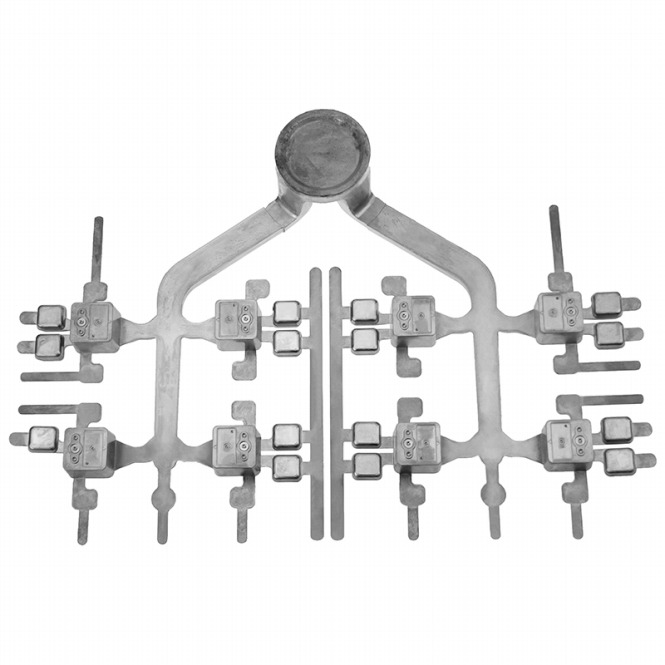
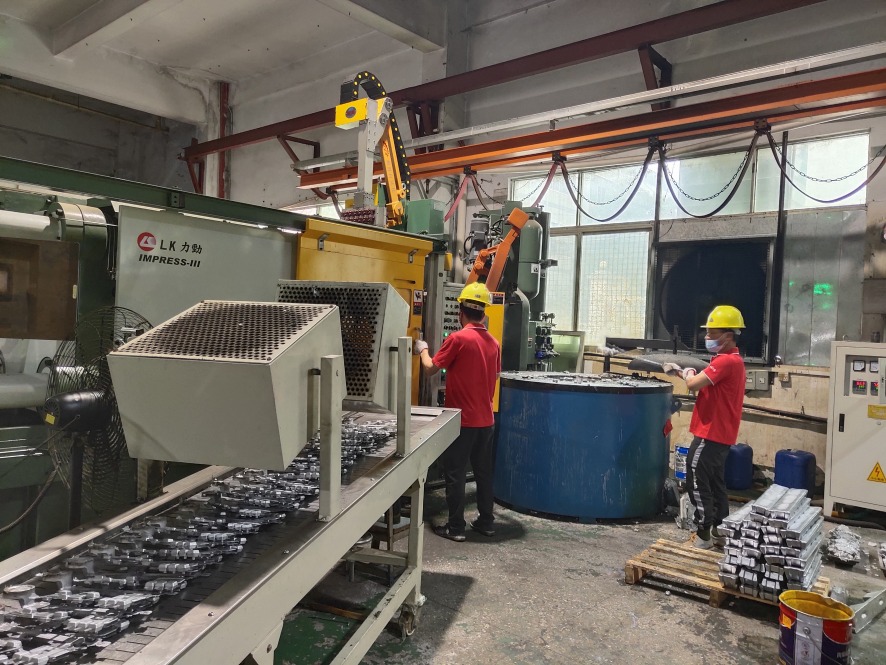
Huayinsheng focuses on high-pressure die casting. Molten ADC12 is injected into a reusable steel die at high speed and pressure. This process is valuable when the design requires:

  • Thin walls and long flow paths
  • Ribs, bosses, pockets and mounting features
  • Good repeatability at production volume
  • Part consolidation that removes brackets, fasteners or welds
  • Limited machining on selected critical surfaces

The tradeoff is that high-pressure filling can trap gas, and local solidification can create porosity. The location and distribution of that porosity matter when the part is machined, sealed, loaded or heated.

What Is Forged Aluminum?

Forging shapes solid aluminum through compressive force, usually at an elevated temperature below the melting point. Open-die, closed-die, roll and other forging methods are selected according to size, shape, material and required properties.

Deformation refines and directs the wrought structure. With the right alloy, heat treatment and forging route, this can provide excellent strength, toughness and fatigue performance. That is why forgings are common in highly loaded aerospace, transportation and industrial components.

But a forging rarely leaves the press as a complete complex assembly-ready shape. Flash trimming, heat treatment, straightening, machining and nondestructive inspection may all be part of the final route.

Is Forged Aluminum Always Stronger Than Cast Aluminum?

Often, but that sentence needs conditions. Strength is not a property of the word “forged” or “cast” alone. It depends on:

  • Alloy and temper
  • Section thickness and geometry
  • Grain or flow orientation relative to service loads
  • Porosity and other internal discontinuities
  • Heat treatment
  • Machining direction and surface condition
  • Static, impact or cyclic loading

A forged 7075 or 6061 component cannot be compared fairly with an ADC12 die casting by process name alone. They use different alloy families and are normally selected for different combinations of castability, heat treatment, strength, corrosion, machining and cost.

Buyer warning: Do not accept a generic “forged is twice as strong” claim without the alloy, temper, test direction, specimen condition and required property. Compare drawing requirements with certified data for the actual material route.

Where Die Casting Wins: Geometry and Part Consolidation

The strongest commercial argument for die casting is not that it beats forging in tensile strength. It is that a well-designed casting can replace a machined block or several assembled pieces with one repeatable near-net-shape component.

Features that often favor die casting include:

  • Integrated mounting bosses and standoffs
  • Thin enclosure walls with reinforcing ribs
  • Internal pockets and external cosmetic surfaces
  • Cast holes that reduce later drilling
  • Locating features that simplify assembly
  • High annual quantity that can absorb tooling investment

Huayinsheng operates machines from 88T to 400T and commonly produces ADC12 parts. Aluminum walls around 1.5 mm may be feasible after reviewing part size, flow distance, geometry and tooling. This is a DFM result, not a universal promise.


Where Forging Wins: Severe Loads and Fatigue-Critical Service

Forging deserves serious consideration when failure risk is controlled primarily by material integrity and fatigue performance rather than geometric integration.

Conditions that may favor forging include:

  • High cyclic or impact load
  • Critical directional load paths
  • Low tolerance for internal porosity
  • A relatively compact and forgeable shape
  • Aerospace or safety-critical requirements tied to wrought alloys
  • Extensive machining is acceptable within the cost target

If the drawing requires a wrought alloy, a specific grain-flow orientation or forging-qualified mechanical properties, conventional ADC12 high-pressure die casting is not a substitute.

Which Process Costs Less?

Material price alone cannot answer this question. Buyers should compare the complete delivered route:

Total delivered cost = tooling + raw material + forming + trimming + heat treatment + machining + finishing + inspection + assembly + scrap risk + logistics

A die-casting tool can require substantial initial investment. At low volume, CNC machining from stock—or sometimes a simpler casting or forging route—may be more economical. At higher volume, die casting can reduce unit cost when it removes machining, combines components and shortens assembly.

Forging tooling also costs money, and the forged blank may still need extensive CNC machining. If 60% of the forged volume is later cut away, the buyer should compare material utilization, machining time and chip handling—not only the forged blank price.

Five Questions That Usually Decide the Process

  1. What actually causes failure? Static overload, fatigue, leakage, deformation, corrosion, heat or appearance?
  2. How complex is the geometry? Can one casting replace several machined or assembled features?
  3. What is the real annual volume? Tooling economics change completely between hundreds and hundreds of thousands.
  4. Which surfaces truly require machining? Do not machine every surface because the prototype was made from billet.
  5. What evidence is required? Material certificate, tensile test, fatigue data, X-ray, leak test, CMM report or process approval?

DFM: Do Not Send the Same Geometry to a Forge and a Die Caster

A part designed for machining or forging is rarely an optimized die casting. Simply replacing the material callout can create thick sections, poor flow paths, trapped air, excessive machining and unnecessary cost.

When converting a part to die casting, review:

  • Uniform wall strategy instead of a solid block
  • Ribs that provide stiffness without creating hot spots
  • Draft, radii and practical parting-line direction
  • Space for gates, vents and overflows
  • Machining stock only where function requires it
  • Sealing and highly loaded regions relative to expected porosity
  • Whether separate components can be consolidated safely

The best cost reduction usually comes from redesigning for the selected process, not asking two suppliers to force the same CAD model through different equipment.

When Should You Choose ADC12 Die Casting?

ADC12 high-pressure die casting is a strong candidate when the project needs complex geometry, good castability, repeatable volume production and selective CNC finishing—but does not require wrought-alloy properties.

Huayinsheng can review the route from drawing and tooling through ADC12 casting, CNC machining, outsourced surface finishing through qualified long-term partners, assembly, inspection and packaging. If the drawing’s load case or specification clearly points to forging, we should identify that before a die-casting tool is ordered.

Frequently Asked Questions

Is forged aluminum stronger than cast aluminum?

Forgings often provide better strength, toughness and fatigue performance for highly loaded applications, but a valid comparison must specify the alloy, temper, geometry, loading and test condition.

Is cast aluminum weaker because it contains porosity?

Porosity can affect properties, especially when it is located in critical sections or exposed by machining. A properly designed casting controls risk by matching alloy, process, geometry and inspection to the application.

Which is cheaper, cast or forged aluminum?

It depends on geometry, production volume, tooling, machining and testing. Die casting often gains an advantage for complex high-volume parts; forging can be appropriate for simpler highly loaded parts even when additional machining is required.

Can a forged aluminum part be converted to die casting?

Sometimes, but only after reviewing the load case, alloy requirement, wall strategy, porosity-sensitive areas, annual volume and redesign opportunities. It should not be treated as a direct material substitution.

Choose the Process from the Part—not from a Sales Pitch

Send Huayinsheng your drawing, load requirements, annual quantity and finishing scope. We will evaluate whether ADC12 die casting is a practical route before discussing tooling.

Send Your Drawing for Review

Related News
Leave me a message
X
We use cookies to offer you a better browsing experience, analyze site traffic and personalize content. By using this site, you agree to our use of cookies. Privacy Policy
RejectAccept